 how-to
Commercial Cleaning Service Pricing Guide for 2026
Table of Contents
- Commercial Cleaning Pricing at a Glance
- Commercial Cleaning Rates per Square Foot
- Hourly Rates and What Drives the Number
- How to Quote Commercial Cleaning Jobs
- Using a Commercial Cleaning Pricing Calculator
- Commercial Cleaning Contract Checklist
- Cost Factors That Move Your Commercial Cleaning Pricing
- Conclusion
- Frequently Asked Questions
Last Updated: October 19, 2026
Commercial Cleaning Pricing at a Glance
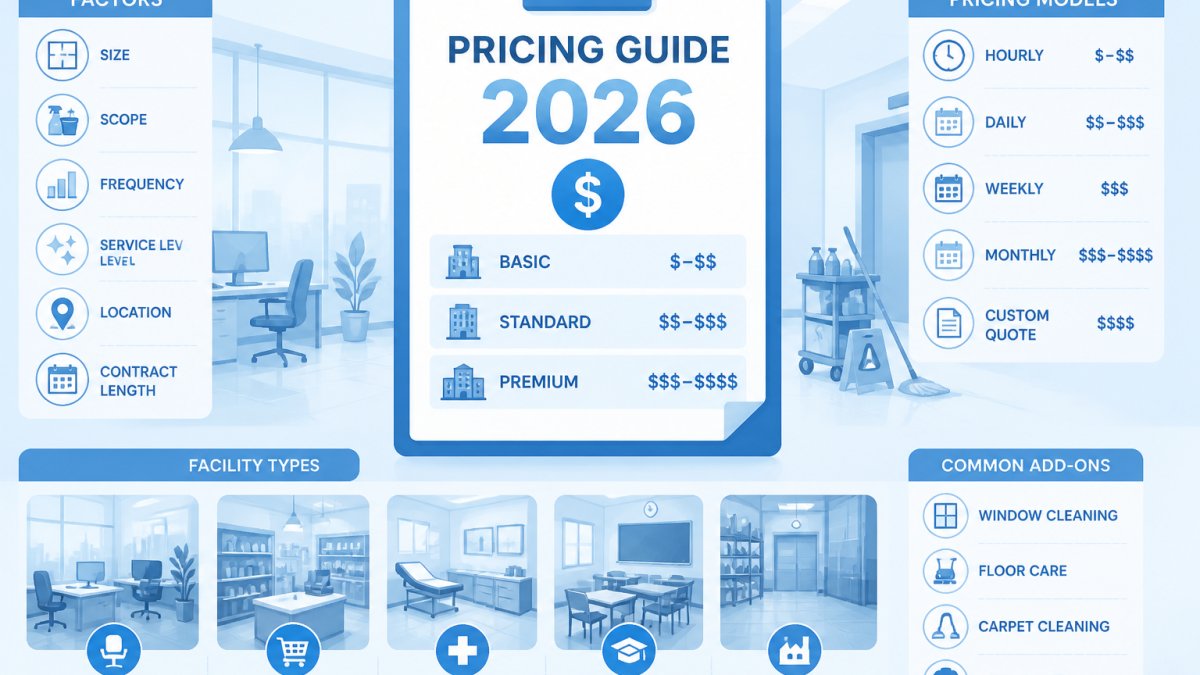
This commercial cleaning service pricing guide starts with the number every office manager wants first: commercial cleaning typically runs $0.05 to $0.40 per square foot, depending on scope and facility type.
Commercial cleaning pricing is the total charge for routine janitorial work, calculated from cleanable square footage, cleaning frequency, and labor hours.
Three numbers anchor nearly every quote:
- Per square foot: $0.05 to $0.40, per ISSA's commercial cleaning rate analysis
- Hourly rate: $20 to $80 for labor
- Monthly minimum: most recurring contracts start around $500
What most guides miss is that the per-square-foot rate is a starting point, not a price. Restroom count, floor types, and access hours move the final number more than square footage does.
Commercial Cleaning Rates per Square Foot
Rates per square foot vary widely because published ranges measure different things. A general office rate covers vacuuming, trash, and wipe-downs.
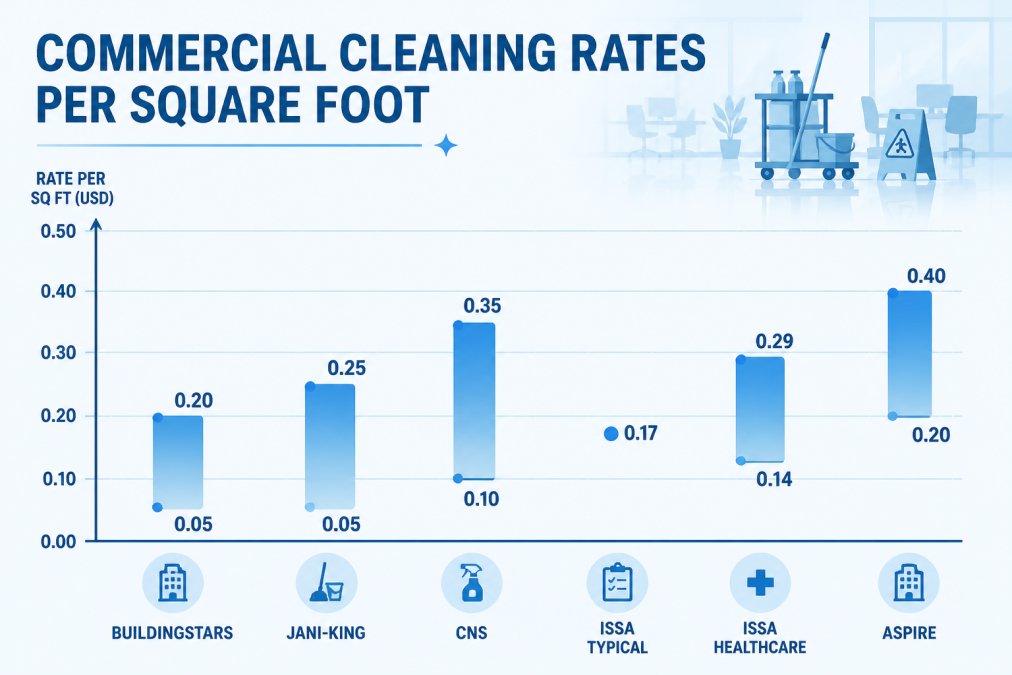
Here is how published ranges compare:
| Source | Rate per Square Foot | Best For |
|---|---|---|
| Buildingstars | $0.05 - $0.20 | Small to large offices |
| Jani-King | $0.05 - $0.25 | Broad commercial spaces |
| CNS Cleaning Co. | $0.10 - $0.35 | Regional 2026 comparison |
| ISSA (typical model) | $0.17 | Industry reference point |
| ISSA (healthcare) | $0.14 - $0.29 | Medical and clinic spaces |
| Aspire | $0.20 - $0.40 | General plus floor care |
The spread looks confusing until you notice the pattern. Lower ranges usually assume open office space with light traffic. Higher ranges assume restrooms, hard floors, and specialty work.
A common mistake is comparing a $0.08 quote to a $0.30 quote as if they cover the same work. They almost never do.
Hourly Rates and What Drives the Number
Hourly rates for commercial cleaning land between $20 and $80, with most established companies in the $25 to $50 band. That range is wide because it folds in wages, supplies, equipment, overhead, and profit margin.
Labor is the biggest line item. Cleaning is a people business, so wages drive the hourly rate more than any other cost.
What sits inside a typical hourly rate:
- Wages and payroll taxes: the largest share
- Supplies and cleaning products: chemicals, liners, paper goods
- Equipment: vacuums, floor machines, carts
- Overhead: insurance, vehicles, supervision, scheduling
- Profit margin: what keeps the business running
A crew that cleans fast but misses spots costs more in the long run than a crew that works steadily. Consistency is the product.
How to Quote Commercial Cleaning Jobs
Quoting a commercial cleaning job means measuring the space, timing the work, and pricing labor plus supplies plus margin. Skip a step and the quote either scares the client away or loses money. The method below matches what most established contractors do, and it adds the piece most rate guides skip: an itemized example you can compare against any bid you receive.
Here is the process most established contractors use:
- Walk the site. Count restrooms, note floor types, and check trash volume.
- Measure cleanable area. Exclude storage, closets, and equipment rooms.
- Set the task list. List every task per visit, from vacuuming to disinfection.
- Time the work. Estimate labor hours per task, then add them up.
- Price the labor. Multiply hours by your fully burdened hourly rate, not just the wage.
- Add supplies and overhead. Include a realistic supply allowance and a share of fixed costs.
- Add margin. Build in profit so the contract survives a slow month.
- Write the scope. Put every task in writing before sending the quote.
The labor-burden math most quotes hide
A cleaner who earns $16 an hour does not cost $16 an hour. Payroll taxes, workers' compensation insurance, paid time off, and supervision typically add a meaningful percentage on top of the base wage.
A simple way to see it: if base wages are $16 an hour and burden adds roughly 25% to 35%, the true labor cost is about $20 to $22 an hour before supplies, equipment, overhead, and profit. A quote built on the $16 wage will lose money on every visit.
An itemized sample quote
Here is how a realistic recurring office quote breaks down. The numbers are illustrative, but the structure is what you should expect to see from a transparent bidder.
| Line item | Basis | Monthly amount |
|---|---|---|
| Labor | 60 hours at $22 burdened rate | $1,320 |
| Supplies | Chemicals, liners, paper goods | $120 |
| Equipment | Vacuum, cart, floor machine share | $60 |
| Overhead | Insurance, vehicles, scheduling, supervision | $180 |
| Margin | Target profit on the contract | $220 |
| Total | $1,900 |
That total works out to roughly $0.19 per square foot for a 10,000-square-foot office cleaned five nights a week.
What to ask for in any quote
- Labor hours per visit. Two quotes at the same price can hide very different staffing levels.
- Task list per visit. Ask what is included and, just as important, what is excluded.
- Supply responsibility. Confirm whether the contractor or the client provides paper goods and liners.
- Frequency and per-visit rate. A monthly total means little without the visit count behind it.
For a full walkthrough of the pricing method, Housecall Pro's guide to pricing commercial cleaning jobs covers recurring office benchmarks.
Using a Commercial Cleaning Pricing Calculator
A commercial cleaning pricing calculator turns square footage, frequency, and facility type into a rough estimate. It is a starting point, not a final quote.
Most calculators ask for four inputs:
- Cleanable square footage
- Facility type (office, retail, clinic)
- Cleaning frequency
- Service level (basic, deep, specialty)
A mid-sized space of 5,000 to 10,000 square feet often lands in a monthly range of $1,000 to $1,500, per Commercial Cleaning Corporation's cost resource. Smaller offices can fall well below that.
Calculator estimates miss site complexity. A 4,000-square-foot clinic with six restrooms costs more to clean than a 4,000-square-foot open office with one.
Commercial Cleaning Contract Checklist
A commercial cleaning contract checklist protects both sides. It forces the scope of work, service frequency, and service-level agreement into writing before anyone signs.
Use this checklist before signing:
- Scope of work lists every task per visit
- Cleanable square footage is stated
- Cleaning frequency is defined (daily, weekly, monthly)
- Service-level agreement sets quality standards
- Restroom and floor care expectations are spelled out
- Supplies and equipment responsibilities are assigned
- After-hours access and security procedures are documented
- Price adjustment terms are included
- Cancellation and renewal terms are clear
- Insurance and bonding are confirmed
The service-level agreement matters most. It defines what "clean" means, so you have a fair way to raise issues without arguing over opinions.
Cost Factors That Move Your Commercial Cleaning Pricing
Several cost factors push commercial cleaning pricing up or down, and most have nothing to do with square footage. Understanding them helps you compare quotes fairly and spot a bid that is too low to be sustainable.
The biggest movers:
- Building size and layout. Larger spaces lower the per-square-foot rate but raise the total. Maze-like layouts slow crews down.
- Facility type. Clinics, restaurants, and retail need more than open offices.
- Cleaning frequency. Daily cleaning costs more per month than weekly cleaning, but the per-visit rate often drops.
- Recurring versus one-time. Recurring contracts earn lower rates because the work is predictable. One-time deep cleaning costs more per visit.
- Specialty cleaning. Carpet cleaning, floor stripping and waxing, and disinfection are priced separately.
- Local market. Wages and competition vary by region, so rates shift from market to market.
- Access and security. After-hours access, badge checks, and alarm codes add labor and coordination.
- Green products. Eco-friendly supplies can carry a modest premium.
Frequency deserves a closer look. Recurring cleaning builds a rhythm, and crews get faster in a familiar space. That efficiency is why recurring contracts usually beat one-time cleaning on value.
How to adjust a national benchmark to your market
Published per-square-foot ranges are national averages. Your local rate will land above or below them based on three things: local wages, the cost of doing business in your area, and how many competitors are bidding for the same work.
A practical method:
- Start with a national benchmark for your facility type, such as the $0.17 typical office figure cited earlier.
- Compare local cleaning wages to the national average. If local wages run higher, raise the rate proportionally; if lower, lower it.
- Adjust for local taxes, insurance, and vehicle costs, which vary by state and metro.
- Check how many local contractors are actively bidding. Thin competition pushes rates up; crowded markets push them down.
Most practitioners find that a market with wages 20% above the national average needs a rate roughly 15% to 20% higher to protect the same margin. The exact number depends on how labor-heavy the scope is.
Price adjustment and contract review
A price is not permanent. Good contracts include a mechanism for adjusting it, and good buyers review that mechanism before signing.
- Annual increases. Many contracts include a fixed annual escalator, often tied to a published inflation index or a set percentage. Ask what the escalator is and when it applies.
- Wage and supply-cost changes. If minimum wage rises or chemical costs spike, the contractor may request an adjustment mid-term. The contract should say how that request is handled.
- Scope changes. Adding a restroom, a kitchen, or a floor-care cycle changes the price. The contract should require a written change order rather than a verbal agreement.
- Renewal terms. Know the notice period for cancellation and whether the contract auto-renews. A 30- or 60-day notice window is common.
What this means for comparing bids
Two quotes that look different on price often differ on scope, staffing, and adjustment terms. Line up the task list, the labor hours, the supply responsibility, and the price-adjustment clause side by side. The lowest number is rarely the lowest cost.
Conclusion
The hardest part of commercial cleaning pricing is not finding a number. It is comparing quotes that describe different work.
El Rey Cleaning Services removes that guesswork. We are family owned and operated, and we quote one clear price up front with no hidden fees. Our team delivers consistent cleaning standards on every visit, with flexible scheduling that fits your hours.
Call for a free estimate and get a written scope with your price.
Frequently Asked Questions
How are commercial cleaning rates calculated per square foot?
Most providers multiply your cleanable square footage by a per-square-foot rate, then adjust for frequency, facility type, and site complexity. Published ranges vary widely: Buildingstars cites $0.05 to $0.20 per square foot, Jani-King cites $0.05 to $0.25, and ISSA reports many models use $0.17. Healthcare facilities often land higher, at $0.14 to $0.29 per ISSA. Ask for the rate, the frequency assumption, and the scope behind any quote so you can compare fairly.
Is it better to price commercial cleaning by the hour or by square foot?
Square-foot pricing suits recurring contracts because it ties cost to the space and stays predictable month to month. Hourly pricing fits one-time or deep cleaning where scope varies. Housecall Pro lists recurring office cleaning at $0.10 to $0.20 per square foot and hourly rates of $20 to $80. For a recurring janitorial contract, ask for square-foot pricing with a defined task list; for a one-time project, hourly or flat-fee pricing is easier to audit.
What should a commercial cleaning quote include?
A complete quote names the cleanable square footage, service frequency, task list by area (restrooms, floor care, breakrooms, trash), supplies and equipment responsibility, after-hours access terms, and the contract length. It should also state what is excluded, such as carpet extraction or stripping and waxing, which Aspire lists at $0.30 per square foot and above. Get the price in writing with no hidden fees, and confirm the start date and any price adjustment clause.
How much does it cost to clean a 6,000-square-foot office?
Apply a per-square-foot rate to the cleanable area. At the $0.10 to $0.20 recurring office range Housecall Pro reports, a 6,000-square-foot office lands roughly between $600 and $1,200 per service visit, though frequency, restroom count, and floor types shift that figure. A commercial cleaning pricing calculator using the same inputs gives a fast ballpark. Request a site walkthrough for an exact quote, since layout and soil level change labor hours.