 comparison
Flexible Scheduling vs Gift of Time: Office Productivity
Table of Contents
- Flexible Scheduling vs Gift of Time: What's the Real Difference?
- How Flexible Scheduling Impacts Employee Focus
- The Impact of Office Environment on Employee Focus
- The Benefits of Commercial Cleaning Services for Your Workplace
- Outsourcing Office Maintenance for Productivity Gains
- Building a Managerial Implementation Guide for Both Models
- Which Approach Delivers the Best ROI?
- Conclusion: Balancing Employee Autonomy with Operational Efficiency
- Frequently Asked Questions
Last Updated: September 5, 2026
Flexible Scheduling vs Gift of Time: What's the Real Difference?
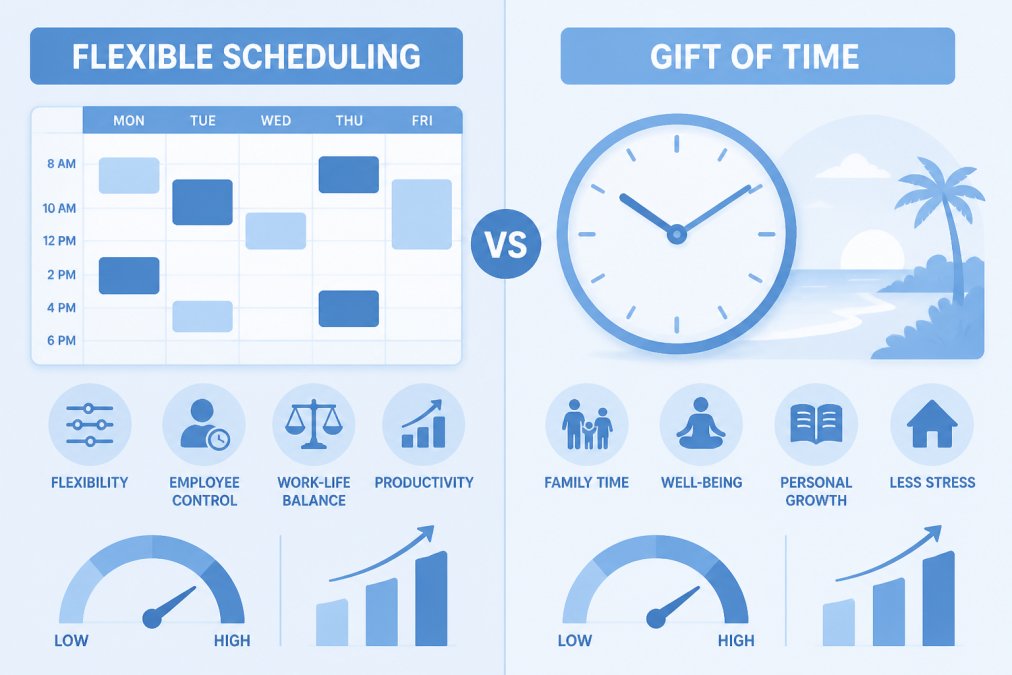
Most leaders treat "flexible scheduling" and the "gift of time" as interchangeable perks. They are not. Flexible scheduling is a structural policy that lets employees choose when they work, while the gift of time is a service philosophy that removes time-consuming burdens from clients and staff entirely. This guide from El Rey Cleaning Services breaks down how each model works in practice.
Flexible scheduling gives your team control over their start times, break lengths, and remote days. The gift of time means you invest in services that hand hours back to your people, so they focus on high-value work instead of maintenance tasks. Both reduce stress and improve job satisfaction, but they solve different problems: one manages when work happens; the other eliminates work that shouldn't happen.
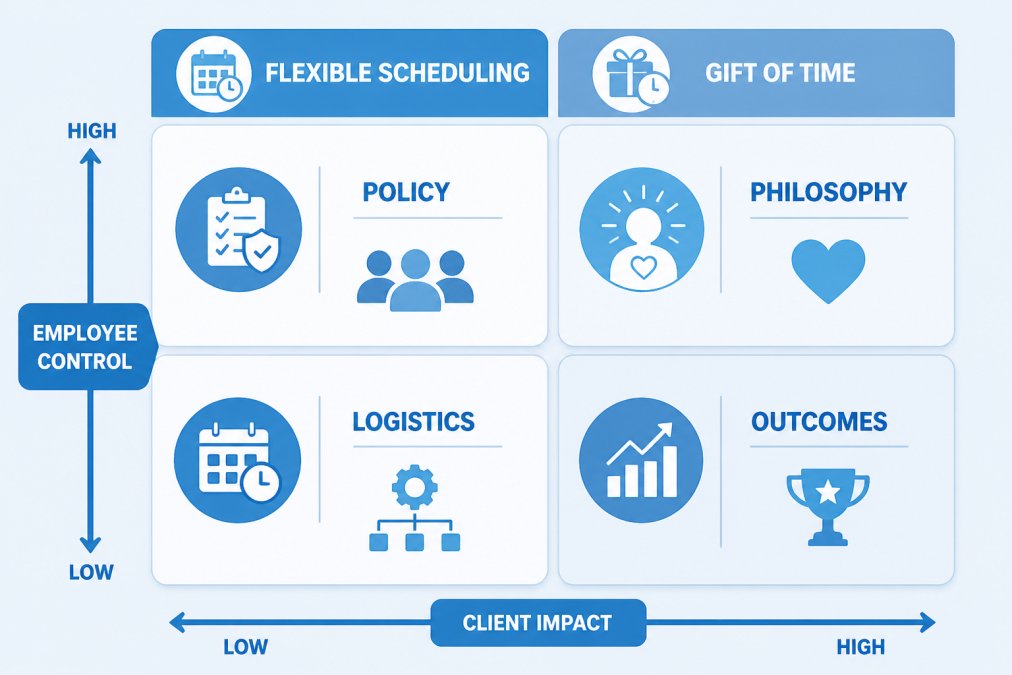
The core tension between flexible scheduling vs gift of time for clients for office productivity boost comes down to ownership. Scheduling policies require employees to manage their own calendars and self-regulate. Gift of time services operate in the background, delivering results without asking anything of your workforce.
How Flexible Scheduling Impacts Employee Focus
Flexible scheduling is a work arrangement that allows employees to choose when they complete their tasks, rather than adhering to a fixed traditional workweek. When implemented well, it directly supports employee autonomy, which many practitioners link to stronger focus and higher engagement during active work hours.
The productivity boost appears when people match their hardest tasks to their natural energy peaks. A morning person tackles deep analytical work at 7 a.m., while a night owl handles the same type of work at 7 p.m. Output-based management replaces the outdated habit of measuring presence instead of performance.
Chronobiology research shows that cognitive performance varies across a 24-hour cycle, with most people peaking mid-morning, dipping after lunch, and rising again in late afternoon (peer-reviewed research). A fixed 9-to-5 schedule forces everyone into the same window, meaning many employees attempt complex problem-solving during their personal trough. Flexible scheduling lets employees align demanding work with their peak windows, often shortening task time and reducing errors.
This alignment also reduces a specific productivity killer: context switching. In a traditional office, an employee might be pulled into an impromptu meeting at 2 p.m., right when they planned to review a contract. With flexible hours, employees can protect their deep-work blocks by scheduling them during hours when colleagues are less likely to interrupt. A common pattern is for employees to start earlier or later than the standard 9-to-5 precisely to gain three or four uninterrupted hours before the rest of the team logs on.
However, flexible scheduling only works when managers shift to output-based management. If you still evaluate employees on hours logged rather than results delivered, the policy creates friction rather than focus. Clear performance metrics and regular check-ins prevent the arrangement from becoming unstructured time that erodes accountability.
A practical framework involves tracking three outputs per week per employee: a completed deliverable, a progress update on a longer-term project, and a collaboration log. When managers evaluate these outputs instead of arrival times, employees stop optimizing for visibility and start optimizing for results.
Predictability also matters. Research suggests employees benefit most when they have both control over their schedule and a predictable routine within that control (apa.org). A completely open schedule can increase cognitive load, as the employee must constantly re-plan their day. The most effective policies establish a rhythm, such as fixed core hours plus a two-hour shiftable window on either end.
Finally, flexible scheduling interacts with the physical workspace in ways that many leaders overlook. An employee who starts at 6 a.m. needs a clean, ready-to-use workspace when they arrive. If the office was not cleaned after the previous day, that early-start employee spends their most productive hours clearing clutter or working in a stale environment. This is where flexible scheduling and the gift of time converge: the policy gives employees control over when they work, but the physical environment determines whether those hours are actually productive.
The Impact of Office Environment on Employee Focus
A clean, organized office environment is the physical foundation for the focus that flexible scheduling enables. Cluttered desks, sticky floors, and overflowing trash bins send a subtle signal that the space, and the work happening in it, does not matter. That perception quietly drags on employee morale and concentration throughout the day.
When your team shares a workspace, the condition of that space affects everyone in it. A spotless kitchen encourages breaks that recharge people. A tidy conference room makes clients take your operation more seriously. Clean restrooms signal respect for daily users.
Dirty environments also create friction that interrupts deep work. Employees waste time searching for supplies, avoiding certain areas, or complaining about conditions instead of focusing on their tasks. These interruptions fragment attention and reduce the quality of output, regardless of how well your flexible scheduling policy performs.
The Benefits of Commercial Cleaning Services for Your Workplace
The benefits of commercial cleaning services extend far beyond aesthetics. A professional cleaning team handles the recurring tasks that drain your operational efficiency, from sanitizing high-touch surfaces to maintaining floors that present your brand well to every visitor.
Consistent professional cleaning reduces the spread of illness, which many HR teams link to lower absenteeism and steadier staffing levels (the CDC). When fewer people call in sick, your flexible scheduling model has more coverage to work with. This is where the gift of time becomes tangible: your employees are not staying late to vacuum or scrubbing the break room on a Sunday.
El Rey Cleaning Services delivers this through reliable commercial cleaning with flexible scheduling built into the service itself. Their team works around your business hours, arriving after close or before open so your workspace is ready when your people arrive. One clear price quoted up front means no hidden fees and no administrative headaches for your office manager.
Outsourcing Office Maintenance for Productivity Gains
Outsourcing office maintenance for productivity is one of the fastest ways to give your team their time back. Every hour an employee spends on tasks outside their role is an hour stolen from the work you actually pay them to do.
Without a professional cleaning team, staff handle trash, dishes, shared desks, and supplies. These tasks interrupt workflow and disproportionately fall on the most conscientious employees, punishing the people you want to retain. Outsourcing eliminates that hidden tax.
This approach also delivers predictable operational efficiency. You do not have to manage cleaning supplies, vet individual cleaners, or worry about coverage when someone is on vacation. A single provider handles all of it with consistent cleaning standards on every visit, which is exactly what El Rey Cleaning Services offers for offices in Wilton Manors. Prompt, communicative service means your office manager can focus on operations instead of coordinating maintenance.
Building a Managerial Implementation Guide for Both Models
A managerial implementation guide starts with an honest assessment of your workplace culture. Flexible scheduling requires trust and output-based management. Gift of time services require a budget and a willingness to delegate. Both require clear communication.
Most articles stop at the 'why.' This section provides the 'how': a concrete, phased implementation sequence managers can follow without losing team cohesion.
Phase 1: The 30-Day Audit (Weeks 1-4)
Before announcing any policy change, run a baseline audit. For two weeks, have each team member log tasks in 30-minute increments, categorized into core role work, administrative work, maintenance work, and collaboration time. Most managers find that 15-25 percent of salaried time goes to tasks outside the core role.
Simultaneously, audit recurring meetings and ask whether each requires all attendees simultaneously. Replace purely informational meetings with asynchronous updates to free up scheduling flexibility before announcing any change.
Phase 2: Policy Design (Weeks 5-6)
Using the audit data, design the flexible scheduling parameters. The most effective structure for most offices is a hybrid model with three tiers:
- Core collaboration hours, 4 hours per day (for example, 10 a.m. to 2 p.m.) when all team members must be available for meetings and synchronous work.
- Flexible buffer windows, 2 hours on either side of the core window that employees can shift to match their energy peaks.
- Fully async days, 1-2 days per week when an employee has no required meetings and can work entirely asynchronously.
For the gift of time component, identify which maintenance tasks appeared in the audit. If cleaning, tidying, or supply management consumed more than 2 hours per employee per week, that is the threshold where outsourcing becomes cost-justified. A simple calculation: multiply the average hourly salary of your team by the hours spent on maintenance tasks. Compare that number against the monthly cost of a professional cleaning service. For a 10-person office where employees earn $30 per hour on average and spend 3 hours per week on maintenance, the weekly cost is $900. A professional cleaning service for a similar office typically costs a fraction of that amount.
Phase 3: Communication and Rollout (Weeks 7-8)
Announce changes with a one-page document covering what changes, what stays the same, and how performance will be measured. The most common failure is ambiguity about performance expectations, which leads employees to disengage and managers to over-monitor, destroying trust.
Define performance metrics before announcing the policy and train managers to evaluate outcomes rather than presence. Under the 'three deliverables' rule, each employee produces three verifiable deliverables per week, agreed upon in advance. This gives managers concrete evidence of productivity without time tracking.
Phase 4: The 90-Day Review (Weeks 12-14)
After 90 days, survey employees on three questions: Has your workload changed? Has your focus improved? What barriers remain? Compare results against the baseline audit to quantify the shift. Teams commonly report a 20-30 percent reduction in perceived busywork within the first quarter.
| Approach | Core Mechanism | Best For | Common Pitfall |
|---|---|---|---|
| Flexible Scheduling | Employee chooses work hours | Deep-focus roles, creative work | Tracking hours instead of output |
| Gift of Time Services | Outsourcing removes burdens | Any team with maintenance duties | Treating it as a perk, not a strategy |
| Hybrid Model | Scheduling plus outsourced support | Most office environments | Implementing one without the other |
The hybrid model is the strongest option. Flexible scheduling gives your people control over their time, and outsourced cleaning gives them back hours they would otherwise lose to maintenance. Together, they create a workplace where autonomy and cleanliness both support peak performance.
One consideration most guides miss: the interaction between flexible schedules and office maintenance. When employees work staggered hours, the office is in use longer each day. A 9-to-5 office might need cleaning once per evening, but an office with employees arriving at 6 a.m. and leaving at 8 p.m. needs a schedule that keeps the space presentable throughout that extended window. The gift of time philosophy thus becomes an operational necessity for flexible workplaces.
Which Approach Delivers the Best ROI?
Measuring ROI requires looking at different metrics. Flexible scheduling improves retention and reduces burnout, lowering recruitment and training costs. Gift of time services improve workplace wellness and the physical environment, supporting daily focus and client perception.
Flexible scheduling delivers returns over quarters and years through lower turnover and stronger talent acquisition. Gift of time services deliver immediate, visible returns daily. A clean office signals to employees and clients that the organization values quality.
The strongest ROI comes from combining both approaches. A workforce that controls its schedule and works in a professionally maintained space is positioned to perform at its best. Neither model replaces the other; they compound.
Conclusion: Balancing Employee Autonomy with Operational Efficiency
The debate between flexible scheduling and gift of time misses the point. The most productive offices use both. Flexible scheduling respects your employees' autonomy and their need for work-life balance, while outsourced commercial cleaning delivers the gift of time by removing maintenance burdens entirely.
At El Rey Cleaning Services, we help Wilton Manors offices achieve this balance with professional, thorough cleaning that runs on your schedule. Our family-owned team provides consistent results from baseboards to countertops, with one clear price quoted up front and no hidden fees.
Call for a free estimate and give your team back the hours they deserve.
Frequently Asked Questions
What is the 'gift of time' concept in professional services?
The 'gift of time' is a philosophy where a service provider's primary deliverable is freeing up the client's schedule. Instead of just completing a task like cleaning, the focus is on the hours returned to the client to spend on their business, family, or rest. This is a core value for services like El Rey Cleaning, where the outcome is not just a spotless office but more productive time for your team.
Can flexible scheduling lead to decreased office collaboration?
It can, if not managed carefully. When people work at different times, spontaneous problem-solving and team meetings become harder. However, you can mitigate this by establishing core overlap hours for collaboration and using asynchronous communication tools for updates. The goal is to blend the focus benefits of flexible hours with structured windows for teamwork, preserving workplace culture without sacrificing individual productivity.
Is it better to have a strict schedule or flexible working hours?
The best approach depends on your business model and the nature of the work. Strict schedules are essential for roles requiring real-time customer interaction or physical presence. Flexible working hours often boost job satisfaction and focus for deep-work tasks like writing or coding. A hybrid model that offers a 'gift of time' through reliable service while allowing employees some schedule control often provides the best of both worlds.
How does a clean office environment impact employee productivity?
A clean office directly impacts employee focus by reducing visual distractions and eliminating health hazards that cause sick days. When employees aren't worried about clutter or dusty surfaces, they can concentrate better on their tasks. Professional commercial cleaning services ensure this is handled consistently, which contributes to a professional atmosphere that boosts morale and shows employees their wellbeing matters.
This article was written using GrandRanker