 listicle
Professional Cleaning Services for Retail: 2026 Guide
Last Updated: October 23, 2026
Quick Summary
Professional cleaning services for retail cover janitorial work, floor care, window and glass cleaning, and sanitizing high-touch areas, bundled into one program so no task falls between vendors. Retail cleaning is customer-facing, so presentation counts as much as hygiene, which drives more frequent floor care and tighter scheduling around store hours.
- Retail cleaning splits into janitorial, floor care, windows and glass, and sanitizing high-touch surfaces.
- Schedule daily tasks at opening or after hours, and periodic floor and window work quarterly.
- Overnight, early-morning, and day porter patterns each carry different access and cost trade-offs.
- Quotes vary 15-25% on layout alone, so normalize scope and frequency before comparing prices.
- Vet providers on references, insurance, staff screening, and a written SLA with remedies.
Table of Contents
- What Professional Cleaning Services for Retail Actually Cover
- Retail Cleaning Checklist by Area
- Building a Retail Cleaning Schedule Around Store Hours
- Retail Floor Cleaning Services: Carpet, Hard Floor, and High-Traffic Zones
- What Drives Cost in Retail Cleaning Contracts
- How to Vet a Retail Cleaning Provider and Set an SLA
- Measuring Cleaning Quality and Business Outcomes
- Frequently Asked Questions
What Professional Cleaning Services for Retail Actually Cover
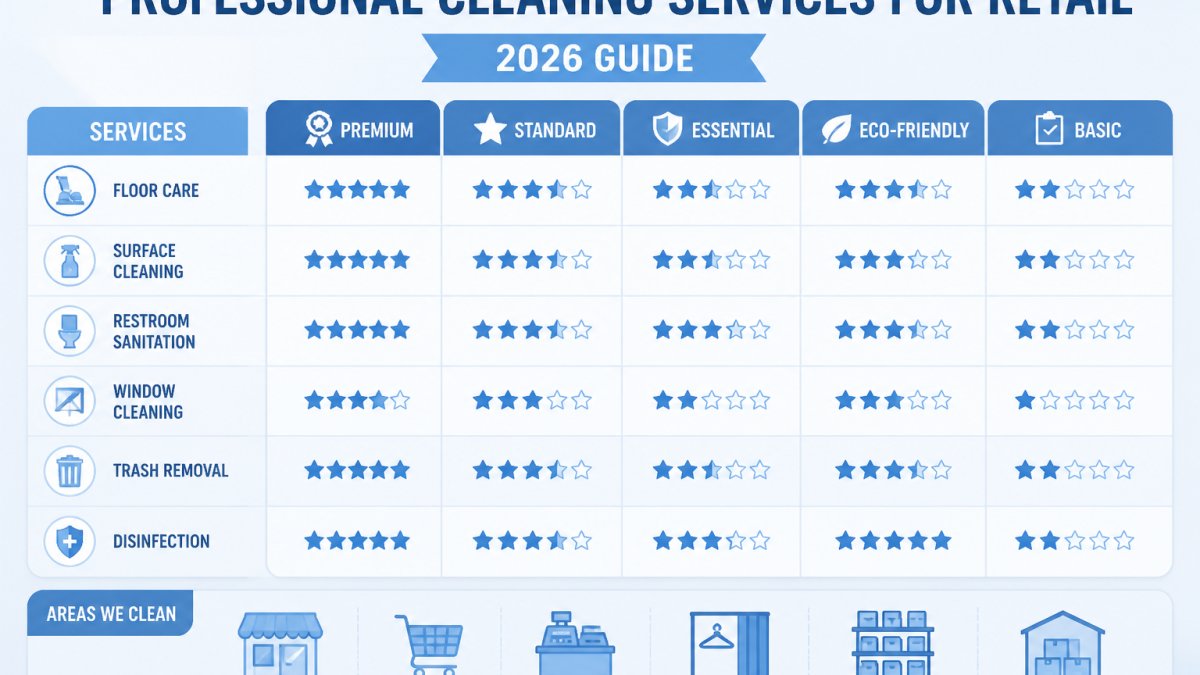
Professional cleaning services for retail cover the routine and periodic work that keeps a store safe, presentable, and ready for customers: janitorial tasks, floor care, window and glass cleaning, surface dusting, and sanitizing high-touch areas. Retail cleaning is its own discipline because a store's cleaning needs differ from an office's. Readers weighing whether to hire a provider can review the benefits of professional retail store cleaning.
The scope usually splits into four buckets:
- Janitorial and routine maintenance: trash removal, restroom cleaning, breakroom upkeep, spot mopping, and day porter coverage during busy hours.
- Floor care: vacuuming, carpet extraction, hard-floor cleaning, and periodic floor stripping and waxing.
- Windows and glass: storefront glass, entry doors, and interior display glass.
Core Scope: Janitorial, Floor Care, Windows, and Sanitizing
Janitorial work handles the daily grind, while floor care, window washing, and disinfection run on longer cycles. A typical retail cleaning program bundles all four so no task falls between vendors. Day porter staffing matters here: a porter who empties trash and spot-cleans during open hours prevents the end-of-day crew from arriving to a mess that has already cost you customers.
What Separates Retail Cleaning From Office Cleaning
Retail cleaning is customer-facing, so presentation counts as much as hygiene. Shopping areas, storefronts, and fitting rooms get more foot traffic and more visible soil than a typical office. Offices can hide a scuffed floor behind a desk; a retail sales floor cannot. That difference drives higher floor-care frequency, more glass cleaning, and tighter scheduling around customer traffic.
Retail Cleaning Checklist by Area
A retail cleaning checklist by area keeps staff and vendors aligned on what "clean" means in each zone. Managers who want a detailed room-by-room version can use a retail store cleaning checklist for managers to hand to staff or compare against a provider's scope. Here is a working version to use as a starting point.
Storefront, Sales Floor, Fitting Rooms, and Restrooms
- Storefront: clean entry glass and door handles, sweep the entry mat, remove exterior trash, and check signage for dust.
- Sales floor: dust shelves and displays, spot mop spills, vacuum traffic lanes, and straighten merchandise areas.
- Fitting rooms: wipe mirrors and benches, remove hangers and tags, vacuum carpets, and disinfect high-touch surfaces.
Building a Retail Cleaning Schedule Around Store Hours
A retail cleaning schedule should separate daily opening tasks, after-hours deep cleaning, and periodic floor and window work so the store never closes for routine maintenance. The schedule below is the framework we recommend for most retail formats.
Daily, Weekly, Monthly, and Quarterly Tasks
| Frequency | Tasks | Timing |
|---|---|---|
| Daily | Trash, restrooms, spot mopping, entry glass, high-touch disinfection | Opening and after hours |
| Weekly | Full floor vacuuming, dusting, fitting-room deep clean | After hours |
| Monthly | Carpet extraction, hard-floor scrub, interior glass | After hours |
| Quarterly | Floor stripping and waxing, exterior window washing | Scheduled closure or slow day |
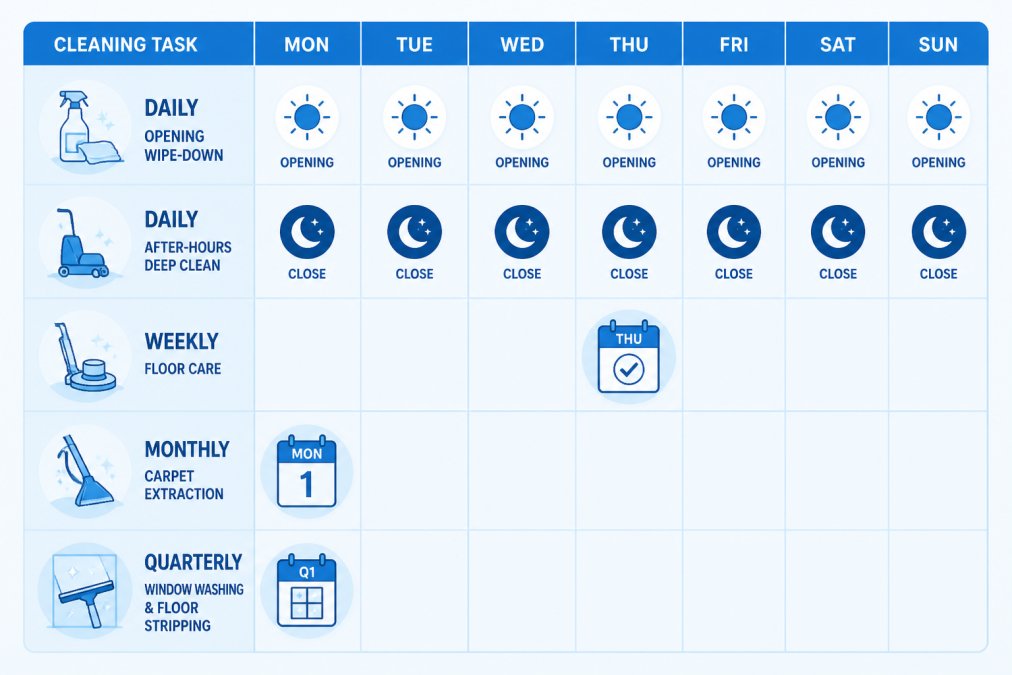
After-hours cleaning protects the customer experience and lets crews use equipment like extractors without disrupting shoppers. Schedule the heavy work when traffic is lowest, and keep a day porter for the in-between hours.
How Store Hours and Traffic Patterns Shape the Schedule
The table above is a starting point, but the right schedule depends on when your store is open and when customers actually arrive. Three patterns cover most retail operations:
- Overnight cleaning (store closed): The default for most stores. Crews arrive after closing and finish before opening, using extractors, buffers, and wet floors without customer exposure. The trade-off is access: someone must arm and disarm the alarm, and the crew needs a key or code plus a clear escalation contact if something goes wrong.
- Early-morning cleaning (store opens late): Common for boutiques and mall tenants with 10 a.m. or 11 a.m. openings. Crews get a two- to three-hour window to vacuum, mop, and clean restrooms before the doors open. The trade-off is a tighter window, periodic floor care usually has to move to a closed day.
- Day porter plus after-hours crew: The pattern for high-traffic stores that cannot wait until closing. A porter handles trash, restroom checks, spill response, and entry-glass touch-ups during open hours, while the after-hours crew does the deep work. This costs more but prevents the mid-day decline that customers notice.
Scheduling by Retail Format
Different retail formats have different cleaning rhythms, and a schedule built for a boutique will under-serve a grocery store:
- Boutiques and specialty shops: Lower foot traffic but high presentation standards. Daily after-hours cleaning plus weekly fitting-room deep cleans and monthly glass and floor care usually suffice. Fitting rooms and mirrors need daily attention because shoppers judge them directly.
- Grocery stores: High traffic, spills, and perishable waste. Daily cleaning with a day porter for spill response, nightly floor scrubbing in aisles and entryways, and frequent restroom checks. Entry floors take grit and weather, so scrub and recoat cycles run shorter than in other formats.
- Malls and shopping centers: Shared common areas complicate scope. Clarify whether the landlord or the tenant cleans corridors, food courts, and restrooms, and schedule tenant cleaning around mall hours and delivery windows.
Whatever the format, write the schedule into the contract with specific days and times, and name who is responsible for access, alarms, and supply restocking. A schedule that lives only in a verbal agreement is the first thing to slip when a crew runs late.
Retail Floor Cleaning Services: Carpet, Hard Floor, and High-Traffic Zones
Retail floor cleaning services combine routine vacuuming with periodic carpet extraction, hard-floor scrubbing, and floor stripping and waxing for high-traffic zones. For deeper guidance, best practices for commercial floor care cover carpet and hard-floor maintenance in busy zones.
High-traffic areas like entrances, checkout lanes, and aisles wear fastest. Increase vacuuming frequency there, and schedule carpet extraction before soil works into the backing.
What Drives Cost in Retail Cleaning Contracts
Retail cleaning costs depend on square footage, service frequency, floor types, fixture density, and whether you need day porter coverage or after-hours crews. Because every store is different, we quote one clear price up front with no hidden fees rather than publish a flat rate. Buyers who want to benchmark quotes can review an after-hours retail cleaning pricing guide to see what drives the number.
The biggest cost levers, and how each one actually moves a quote:
- Square footage and layout: Labor is priced by time, and time scales with cleanable square footage, but layout matters as much as size. A 5,000 sq ft boutique with open sales floor cleans faster than a 5,000 sq ft grocery with dense shelving, refrigerated cases, and narrow aisles that slow a crew down. Ask providers how they measure "cleanable" square footage versus total footprint; the difference often explains a 15-25% spread between quotes.
- Frequency: Daily service costs more per month than twice-weekly, but the per-visit price usually drops because crews stay familiar with the store and soil never reaches the point where it needs extra labor. A common pattern is that twice-weekly service costs roughly 60-70% of daily service for the same scope, while daily service prevents the buildup that turns a routine mop into a scrub-and-recoat job.
- Floor care: Carpet extraction and hard-floor stripping and waxing are periodic line items, not routine ones. They carry equipment and labor premiums, extraction and stripping and waxing carry equipment and labor premiums, so a quote that omits them looks cheaper until the first periodic cycle arrives.
When you compare quotes, normalize them first: same scope, same frequency, same periodic tasks, same supply responsibility. Only then does the price difference mean anything.
How to Vet a Retail Cleaning Provider and Set an SLA
Vetting a retail cleaning provider means checking references, insurance, staff screening, and whether the contract spells out scope, service frequency, and remedies for missed work. A service-level agreement (SLA) turns vague promises into measurable terms: what gets cleaned, how often, and what happens when a task is missed. An office cleaning contract terms guide walks through scope, SLAs, cancellation clauses, and insurance so you can read every clause before signing.
Ask these questions before you sign:
- Can you provide references from retail clients with similar square footage?
- Are staff screened and insured, and who supervises each visit?
- What is the response time for a missed task or emergency cleaning?
Measuring Cleaning Quality and Business Outcomes
Cleaning quality is measurable if you define the standard up front and inspect against it. Use a simple scoring rubric on a walk-through: rate floors, restrooms, glass, and high-touch surfaces on a 1-5 scale each visit, and track the trend.
Tie the scorecard to business results. Well-kept stores support illness prevention through consistent disinfection of high-touch surfaces, and they protect the shopping experience that keeps customers returning.
Frequently Asked Questions
What does professional retail cleaning include?
A standard retail cleaning program covers storefront and entrance glass, sales floor dusting and vacuuming, fitting room resets, restroom cleaning and disinfection of high-touch surfaces, trash removal, and floor care. Many contracts add carpet extraction, hard-floor stripping and waxing, and window washing on a set frequency. Ask for a written scope by area so you know what happens daily versus monthly, and confirm whether restroom supplies and after-hours access are included.
How often should a retail store be professionally cleaned?
Most stores need daily or five-day janitorial coverage for restrooms, floors, and trash, with a weekly detail pass and monthly deep cleaning. Carpet extraction usually runs every three to six months depending on foot traffic, and hard floors get stripped and refinished once or twice a year. A retail cleaning schedule should flex with your traffic calendar, so add extra visits during holiday peaks and reduce frequency in slow months.
How much do professional cleaning services for retail stores cost?
Pricing depends on square footage, frequency, floor types, and whether you need after-hours or day porter coverage. Published industry guides report various figures for retail cleaning. Treat those as planning benchmarks, not quotes. Request a walkthrough estimate so the provider prices your actual floor mix and traffic.
Can retail cleaning be scheduled outside business hours?
Yes. After-hours cleaning is standard for retail because it keeps vacuums, floor machines, and chemical use away from shoppers. Most providers work between store close and opening, or in early-morning windows before staff arrive. If your lease or mall rules limit access hours, confirm the window in writing and ask how the crew handles alarm codes, key control, and locked display cases.
What should I look for when hiring a retail cleaning company?
Check for retail-specific experience, written scope by area, a named supervisor, insurance, and a clear quality check process. Ask how they handle high-touch surface disinfection, floor care schedules, and restroom restocking. Confirm response time for spills and emergency cleaning, and get the price quoted up front with no hidden fees. A short trial period with a documented checklist protects you before signing a longer contract.
Keeping a retail store spotless takes more than a mop and a schedule; it takes a crew that shows up, follows the checklist, and treats your storefront like the first impression it is. El Rey Cleaning Services is a family-owned and operated business offering commercial cleaning with one clear price quoted up front, no hidden fees, flexible scheduling, and consistent standards on every visit. Call for a free estimate and get a retail cleaning plan built around your store hours.