 how-to
How Can You Ensure Thorough House Cleaning?
Last Updated: October 24, 2026
Quick Summary
To ensure thorough house cleaning, work from a written plan and clean top to bottom so dust falls onto surfaces you haven't cleaned yet, then finish with floors and a checklist walkthrough. Declutter first, gather all supplies in one caddy, and clean one room fully before moving to the next.
- Cleaning and sanitizing are separate steps: remove soil first, then sanitize the surface.
- Use two cloth colors so bathroom germs never reach kitchen counters.
- Floors always come last, after dusting, wiping, and vacuuming.
- Run the finger test on baseboards and door frames before leaving each room.
- Deep cleaning a maintained 1,000 to 1,500 sq ft home takes a professional team 4 to 6 hours.
Table of Contents
- Why Thorough House Cleaning Starts With a Plan
- How to Prepare for a House Cleaner (or Your Own Deep Clean)
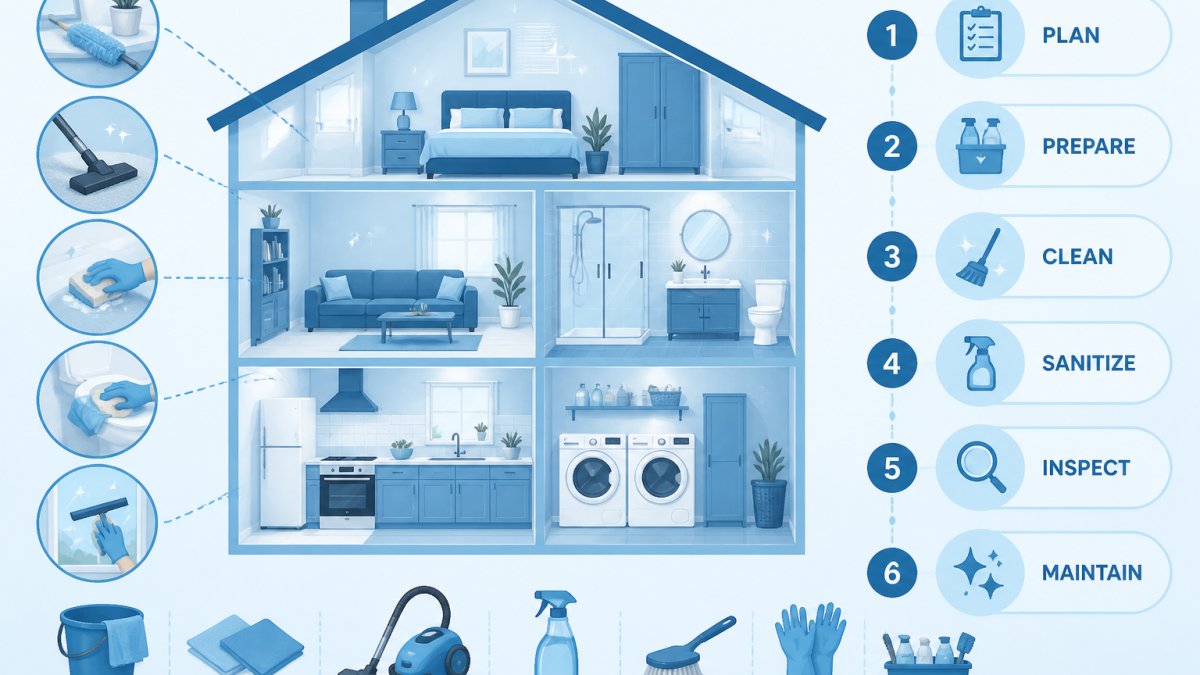
- Gather Your Cleaning Supplies and Tools Before You Start
- Clean Top to Bottom: The Order That Prevents Missed Spots
- The Deep Cleaning Checklist for Spots Regular Cleaning Misses
- How Long Does It Take to Deep Clean a House?
- Book a Thorough House Cleaning You Can Count On
- Frequently Asked Questions
Why Thorough House Cleaning Starts With a Plan
Thorough house cleaning is a structured process that covers every surface, corner, and fixture in a set order, rather than a quick pass with a vacuum and a rag. Most missed spots come from cleaning without a sequence. A written cleaning plan fixes that.
A plan does three things:
- Sets the order of rooms and tasks
- Lists the supplies you need before you start
- Gives you a finish line for each room
The U.S. Department of Agriculture home safety guidance also points out that cleaning and sanitizing are separate steps. You remove soil first, then sanitize. Skip the first step and the second one does less.
How to Prepare for a House Cleaner (or Your Own Deep Clean)
Preparation is where most people lose time. Clear the clutter first. Pick up clothes, toys, dishes, and mail before any cleaning starts.
Next, write down your priorities. If you're hiring, tell the team what matters most: bathroom grout, kitchen appliances, baseboards, or pet hair. Specific instructions beat general ones.
If you're hiring a professional, a little prep makes the visit far more productive. Learn how to prepare for a professional deep clean with practical steps and a post-clean checklist.
Watch out: don't leave breakables or paperwork on counters you expect to be wiped. Cleaners will work around them, and those spots stay dirty.
Gather Your Cleaning Supplies and Tools Before You Start
Walking back and forth for supplies wastes more time than the cleaning itself. Build one caddy and carry it room to room.
What you'll need:
- Microfiber cloths in two colors, one for bathrooms, one for everything else
- A duster with an extendable handle
- All-purpose cleaner and a bathroom cleaner
- A scrub brush and an old toothbrush for grout and tight spaces
- A broom, a vacuum with attachments, and a mop
- Trash bags and a bucket
Two-color cloths matter more than people think. It stops you from spreading bathroom germs onto kitchen counters. Keep a separate cloth for glass, too.
Clean Top to Bottom: The Order That Prevents Missed Spots
Cleaning top to bottom means dust and dirt fall onto surfaces you haven't cleaned yet, so you never redo work. This single rule prevents most missed spots.
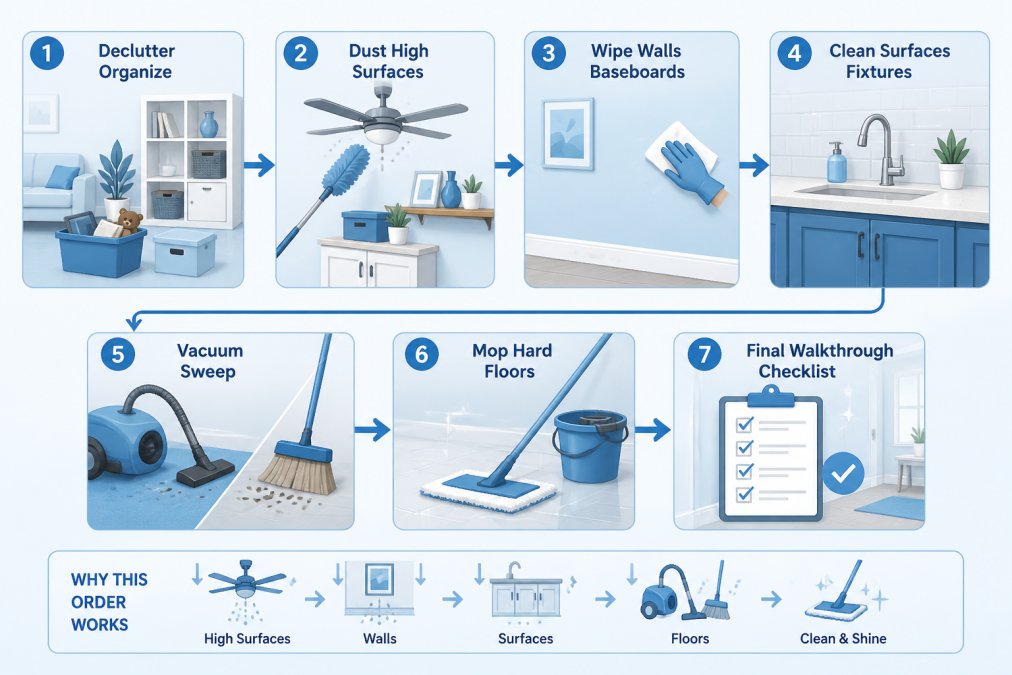
Work order matters as much as the list. Clean the kitchen and bathrooms before bedrooms and living areas, and keep bathroom tools separate from everything else.
Kitchen
- Counters and backsplash: clear items, wipe front to back, then dry. Pass: no visible crumbs, sticky residue, or streaks when the surface is viewed at an angle.
- Sink and faucet: scrub the basin, the drain ring, and the base of the faucet. Pass: no film or grit when you run a finger around the drain.
- Stovetop and hood: degrease the grates and the hood filter face. Pass: no tacky feel on the grates.
- Appliance fronts and cabinet handles: wipe handles last, after the surrounding surface. Pass: no fingerprints on stainless or painted fronts.
- Trash can, inside and out: wipe the lid and the rim. Pass: no odor when the lid is opened.
- Floor: sweep, then mop, and let it dry before replacing mats.
Bathroom
- Toilet: clean the tank, lid, seat, bowl, base, and the floor behind the base. Pass: no ring at the waterline and no dust on the base.
- Shower and tub: scrub the walls, the tub floor, and the grout lines. Pass: grout looks uniform in color, not dark in patches.
- Grout and drain cover: use a brush, not a cloth. Pass: no standing water or hair in the drain cover.
- Mirror and fixtures: Pass: no water spots when the mirror is viewed from the side.
- High-touch surfaces: handles, light switches, and the door knob. Pass: wipe with a clean cloth and see no transfer.
Bedrooms and Living Areas
- Dust furniture: work top to bottom on each piece. Pass: no dust line on the top edge of the headboard or shelf.
- Electronics: wipe screens with a dry microfiber cloth, not a spray. Pass: no streaks or lint.
- Rugs and under furniture: vacuum the visible rug, then move light furniture and vacuum beneath it. Pass: no debris line along the baseboard when the furniture is moved back.
- Baseboards and door frames: Pass: the finger test below.
- Linens: change bed linens and empty the hamper. Pass: no stray hair on the fitted sheet.
The Deep Cleaning Checklist for Spots Regular Cleaning Misses
A deep cleaning checklist targets what weekly cleaning skips. Regular cleaning keeps a home tidy. Deep cleaning removes buildup. The spots below are the ones most often missed, and each one comes with a note on the product and the surface so you don't trade a missed spot for a damaged finish.
Spots people miss most:
- Baseboards and door frames
- Tops of cabinets and the fridge
- Inside the oven and microwave
- Behind and under the toilet
- Shower grout and drain covers
- Light fixtures and ceiling fan blades
- Window tracks and blinds
- Under furniture and area rugs
- Trash cans, inside and out
Product safety, dwell time, and surface compatibility
This is where most deep cleans go wrong. A cleaner that works on tile can dull a sealed stone counter, and a product left on too briefly does nothing at all.
- Read the label first, every time. The label tells you the surface it is approved for, the contact time, and whether ventilation or gloves are required. Follow it over any habit or internet tip.
- Respect dwell time. Disinfectants need the surface to stay wet for the contact time printed on the label, often around 30 seconds to a few minutes depending on the product. If it dries before that, wipe and reapply. Cleaning first, then disinfecting, is the sequence that works; a disinfectant applied over soil does less.
- Ventilate. Open a window or run the exhaust fan when using anything with a strong odor, and keep pets and children out of the room until surfaces are dry.
- Test on a hidden spot. For stone, sealed wood, brass, and painted surfaces, test in a corner first. Abrasive powders and acidic cleaners can etch or dull these finishes.
- Never mix. Bleach with ammonia or vinegar produces dangerous fumes. Keep bathroom and kitchen products separate, and never combine them in the same bucket.
- Match the tool to the surface. Use a non-scratch pad on glass and coated surfaces, a brush on grout, and a dry microfiber cloth on screens and electronics.
A realistic time budget
Deep cleaning a maintained home of about 1,000 to 1,500 square feet typically takes a professional team 4 to 6 hours; a home over 2,500 square feet or one with heavy buildup runs 8 to 10 hours. Doing it yourself usually takes longer because you lose time switching tasks and gathering supplies. Plan the deep clean in zones, kitchen, bathrooms, living areas, bedrooms, and finish one zone before starting the next so a half-done room never gets left behind.
How Long Does It Take to Deep Clean a House?
Deep cleaning a house typically takes 4 to 10 hours for a professional team, depending on home size, clutter, and how many cleaners are working. How long professional deep cleaning takes depends on the same factors. A smaller, maintained home sits at the low end. A large or heavily cluttered home sits at the top.
Rough guide:
- Apartment or small home: 3 to 5 hours
- Mid-size home, average condition: 5 to 7 hours
- Large home or heavy buildup: 8 to 10 hours
Doing it yourself usually takes longer, because you lose time switching tasks.
Here is the rough time guide the article gives for deep cleaning a house.
| Home type | Time | Note |
|---|---|---|
| Apartment or small home | 3 to 5 hours | Low end of the range |
| Mid-size home, average condition | 5 to 7 hours | Typical maintained home |
| Large home or heavy buildup | 8 to 10 hours | Top of the range |
| Maintained home, 1,000 to 1,500 sq ft | 4 to 6 hours | Professional team |
| Home over 2,500 sq ft or heavy buildup | 8 to 10 hours | Professional team |
| Doing it yourself | Longer | Time lost switching tasks |
Book a Thorough House Cleaning You Can Count On
Consistency is the hard part. Anyone can clean well once. Doing it the same way every visit is what separates a real service from a quick wipe-down.
El Rey Cleaning Services is family owned and operated, and we quote one clear price up front with no hidden fees. Every visit follows consistent cleaning standards, and we work from your priorities, not a generic script.
Our customers tell us the difference shows in the details. "Kitchen and bathrooms came out spotless. Fair price and no surprises," one homeowner said after a whole-house deep clean.
Frequently Asked Questions
What is the correct order to clean a house?
Work top to bottom and dry to wet. Start by decluttering, then dust high surfaces like ceiling fans and cabinet tops, wipe walls and baseboards, clean counters and fixtures, vacuum and sweep, and mop hard floors last. This order stops dirt from landing on areas you already cleaned. Finish with a walkthrough checklist so you catch missed corners and tight spaces before you put supplies away.
What areas are most often missed during house cleaning?
The spots most often skipped are baseboards, the tops of door frames, light switch plates, cabinet handles, the area behind the toilet, under furniture, and the inside of trash cans. A room-by-room house cleaning checklist with pass/fail criteria helps: for example, run a white cloth along the baseboard and check for gray residue. If the cloth comes back dirty, the room is not done.
How often should you deep clean your home?
Most homes need a deep clean every three to six months, with weekly maintenance cleaning in between. High-traffic areas like kitchens and bathrooms may need deep cleaning more often, especially if you have pets or allergies.
How can you keep your house clean between professional cleanings?
Set up a simple weekly routine: wipe high-touch surfaces, sweep or vacuum floors, take out trash, and clear counters daily. Keep microfiber cloths and a duster in each room so cleaning takes minutes, not hours. A written cleaning schedule prevents dust accumulation and makes your next professional cleaning faster and more thorough, since the team can focus on deep cleaning instead of surface clutter.
If your last cleaning left spots behind, the fix isn't more effort. It's a better process, and a team that follows it every time. El Rey Cleaning Services brings consistent standards, flexible scheduling, and a spotless finish from baseboards to countertops. Get started with El Rey Cleaning Services and request a free estimate for your home or office.