 how-to
Flexible Scheduling for Tech Startups: A 2026 Playbook
Table of Contents
- Why Rigid 9-to-5 Schedules Are Failing Tech Startups
- The Core Models of Flexible Scheduling for Tech Startups
- How to Write a Flexible Work Policy Template That Actually Works
- Essential Tools for Managing Remote Tech Teams
- Asynchronous Work Best Practices for Deep Focus
- Managing the Risks: Burnout and Collaboration Gaps
- Legal and Compliance Considerations for Flexible Hours
- Common Mistakes to Avoid When Rolling Out Flexibility
- Frequently Asked Questions
Last Updated: September 9, 2026
Why Rigid 9-to-5 Schedules Are Failing Tech Startups
The rigid 9-to-5 schedule is a relic of the industrial era, actively working against the modern tech startup. For companies competing on talent density and agility, forcing everyone into the same synchronous window ignores that deep work rarely fits a fixed block. Flexible scheduling lets startups retain top engineers, support distributed teams, and measure output instead of hours at a desk.
The same principle applies to tech: when you trust your team to manage their own hours, you signal respect for their judgment. This guide breaks down the core models, policy framework, and tooling to make flexibility work without sacrificing collaboration or accountability.
The biggest mistake founders make is treating flexible scheduling as a binary choice between "everyone remote" and "everyone in the office." The reality is a spectrum of models, each with distinct trade-offs. Below, we'll show you how to choose the right structure and write a policy that survives reality.
The Core Models of Flexible Scheduling for Tech Startups
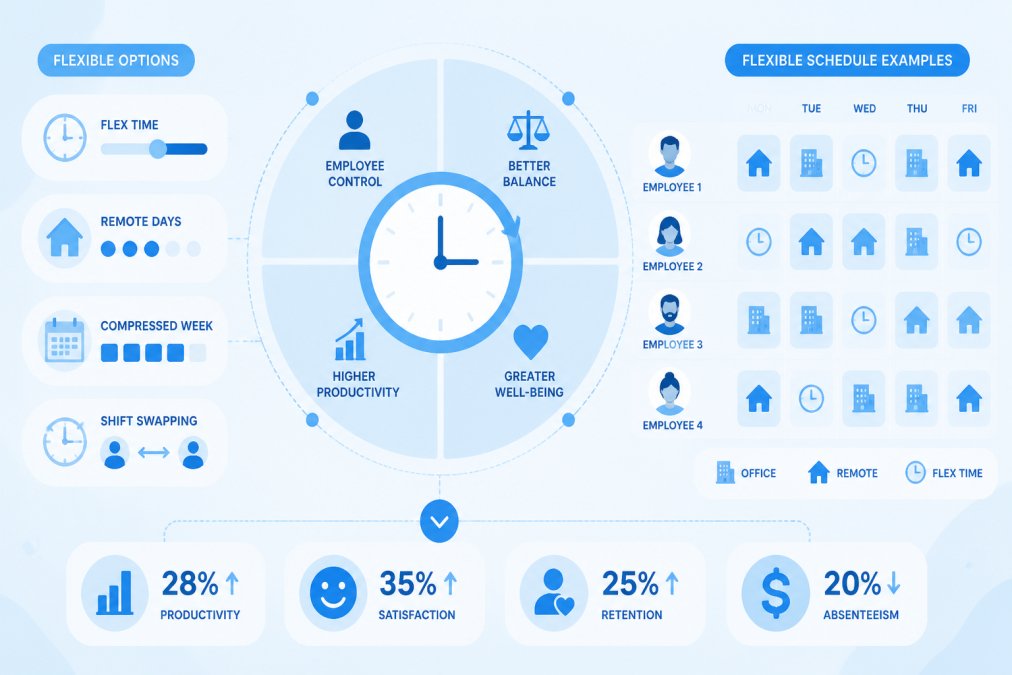
Flexible scheduling for tech startups falls into four primary models, each balancing flexibility against collaboration level. The right choice depends on team size, product stage, and how much synchronous communication your workflow requires.
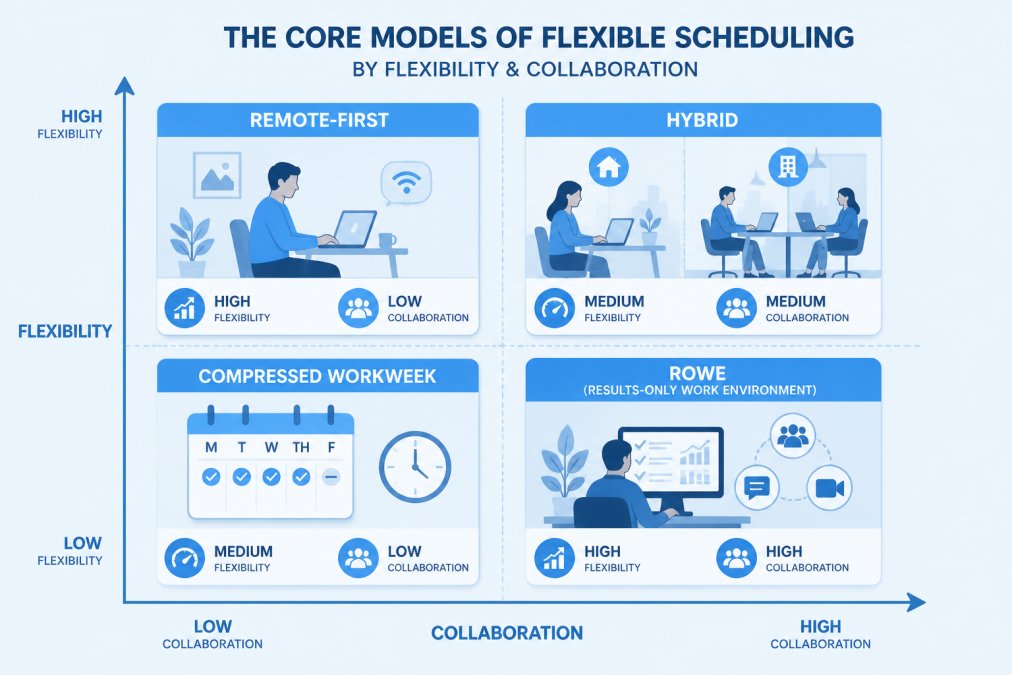
Remote-First vs. Hybrid Models
Remote-first means the default assumption is that employees work from anywhere, and the office, if it exists, is an optional gathering space. Hybrid models split time between remote work and mandated in-office days, typically two to three days per week for synchronous collaboration.
Remote-first maximizes talent acquisition but demands disciplined asynchronous communication. Hybrid models preserve spontaneous hallway conversations, yet can create a two-tier culture where remote days feel less productive. Most startups under 50 people succeed with remote-first; hybrid works better once you have dedicated office space and trained managers.
Compressed Workweeks and Flextime
A compressed workweek condenses full-time hours into fewer days, commonly four 10-hour days, giving employees a three-day weekend (bls.gov). Flextime keeps the five-day structure but lets employees choose their start and end times within a defined window.
Compressed schedules can boost engagement but require careful staff scheduling for coverage during core hours. Flextime is easier: define a mandatory overlap window, often 10:00 AM to 3:00 PM, and let employees manage the rest. The key is results-based management, evaluating output rather than punishing an engineer who starts at 11 AM.
Results-Only Work Environments (ROWE)
A Results-Only Work Environment (ROWE) eliminates fixed schedules entirely. There are no required meetings, no core hours, and no expectation of when work happens, only that agreed-upon outcomes are delivered on time.
ROWE is the purest expression of output-oriented culture, attracting senior talent who thrive on autonomy. It fails when the team lacks strong project management or when junior employees need synchronous mentorship. For startups with high talent density, ROWE can be transformative; for early teams, it often creates collaboration gaps that slow iteration.
| Model | Schedule Flexibility | Collaboration Level | Best For |
|---|---|---|---|
| Remote-First | High | Low-Medium | Distributed teams, global hiring |
| Hybrid | Medium | Medium | Teams needing office culture |
| Compressed Week | Medium | Low | Reducing burnout, long weekends |
| Flextime | Medium | Medium-High | Easy first step into flexibility |
| ROWE | Very High | High (if managed well) | Senior, self-directed teams |
How to Write a Flexible Work Policy Template That Actually Works
A flexible work policy template is only useful if it addresses the operational details most companies ignore. Start with the baseline: define which roles are eligible and how performance will be evaluated.
A strong policy template includes five sections: eligibility criteria, core collaboration hours, communication expectations, performance metrics, and the review process. State explicitly that flexible scheduling is a privilege tied to consistent output, not an entitlement. Include a 30-day trial period for any new arrangement, and require managers to document how productivity is measured before the trial begins.
The most common failure is writing a policy that promises flexibility but leaves managers unprepared to evaluate remote performance. Pair the policy with manager training on results-based management and schedule quarterly reviews.
Essential Tools for Managing Remote Tech Teams
Generic advice to 'use Slack and Notion' fails startups because it ignores the real challenge: choosing tools that enforce asynchronous workflows. The most effective stacks are built around a single source of truth for project status.
The Core Stack: One Source of Truth
The highest-performing startup teams use a project management tool as their system of record. Linear is the default for product engineering teams; Jira is often too heavy for startups under 50 people; Asana works well for cross-functional teams. The key is enforcing a strict policy: all project updates, decisions, and blockers live in the tool, not in chat.
Communication Tools: Configure for Async First
Slack or Discord are necessary, but their default settings actively work against deep focus. The most effective teams configure their workspace with these settings:
- Disable all non-essential notifications by default. New hires should opt-in to channels rather than being auto-added.
- Use threads aggressively. Require that all replies to a message happen in a thread, keeping the main channel clear for new topics.
- Set a 'Do Not Disturb' schedule for each team member's working hours. Respect these boundaries; a message sent outside someone's hours should not expect a response until they are online.
- Create a #standup channel where daily written updates are posted, replacing synchronous standup meetings entirely.
Documentation: The Async Memory
Notion or Confluence serve as the team's collective memory. The rule that separates effective teams from ineffective ones is simple: if a decision was made in a meeting or chat thread, it did not happen until it is written down. Require a 'Decision Log' page where any significant choice is recorded with context, options considered, and rationale. This prevents the 're-litigating closed decisions' problem that plagues async teams.
Time Tracking: Use Sparingly and With Purpose
Time tracking tools like Toggl or Harvest are often necessary for client-billed work, but can create a culture of surveillance if used as a productivity metric. Use them only for tracking billable hours or for a 30-day audit. Do not use them to monitor employee activity; that signals distrust and undermines the entire flexibility initiative.
The Anti-Pattern: Tool Sprawl
A common failure mode is adopting a new tool for every perceived problem. Within six months, a startup can end up with five apps that all have chat features, none of which is the definitive source of truth. The cost is the cognitive load of checking multiple places for information. A practical rule: before adding any new tool, identify which existing tool it will replace. A lean stack of four tools, project management, chat, docs, and video, is sufficient for most startups under 100 people.
Asynchronous Work Best Practices for Deep Focus
Asynchronous communication is the engine of flexible scheduling, and it requires deliberate practice to work well. The core principle is simple: default to written communication that does not require an immediate response.
Adopt a few rules to protect deep focus. Establish a "no meeting Wednesday" block where no synchronous calls are scheduled. Require written agendas for any meeting that does happen. Encourage team members to batch questions into a single daily digest rather than pinging colleagues throughout the day.
The payoff is measurable in productivity metrics, but the transition is hard for teams used to Slack-driven workflows. Start with one asynchronous day per week, and expand as the team builds confidence in written updates and documentation.
Managing the Risks: Burnout and Collaboration Gaps
Flexible scheduling is not a cure-all, and it introduces two significant risks: burnout from blurred boundaries and collaboration gaps from reduced synchronous contact.
Burnout prevention starts with clear expectations. When there is no fixed end to the workday, employees often work longer, not shorter. Set guidelines against after-hours messaging and watch for signs of overwork in output quality. Many startups find that a "core hours" overlap of four hours per day prevents the isolation that leads to disengagement.
Collaboration gaps appear when product decisions are made in async threads without enough debate. Mitigate this by scheduling one mandatory weekly all-hands meeting and pairing junior employees with senior mentors. The goal is not to eliminate synchronous collaboration, but to make it purposeful and scheduled.
Legal and Compliance Considerations for Flexible Hours
Flexible scheduling intersects with wage and hour laws, and startups must handle compliance carefully. The U.S. Department of Labor's overtime rules require that non-exempt employees, those eligible for overtime, track all hours worked, including time spent answering emails or Slack messages after hours.
For exempt employees, typically salaried workers in executive, administrative, or professional roles, the rules differ. The Fair Labor Standards Act guidance provides the framework for who qualifies as exempt, and misclassification carries significant penalties. When implementing flextime or compressed weeks, verify that every employee's classification is correct, and that time tracking systems capture all work for non-exempt staff.
State laws also matter. Some states have predictive scheduling laws requiring advance notice of shift changes, and others regulate meal and rest breaks. Consult employment counsel in your state before rolling out a policy, and document every arrangement in writing.
Common Mistakes to Avoid When Rolling Out Flexibility
The most common mistake is rolling out flexible scheduling without a pilot period. Launch with one team for 60 days and refine the policy before company-wide adoption.
A second mistake is treating flexibility as a perk rather than a management philosophy. If managers still evaluate presence rather than output, the policy will fail. Train managers on performance evaluation based on deliverables.
Third, avoid creating a policy so rigid that it defeats its purpose. A template that requires 15 approval steps for a simple schedule change will be ignored. Keep the process lightweight and revisit the policy quarterly. Many companies also overlook the need to document everything; a clear policy protects both the employee and the company when disputes arise.
The Deeper Problem: Managers Are Untrained for Output-Based Management
The most significant reason flexible scheduling initiatives fail is not the policy itself, it is that first-line managers have spent their entire careers managing by presence. They know how to evaluate someone at their desk from 9 to 5; they do not know how to evaluate someone who delivers exceptional work at 11 PM. This is a training gap, not a policy gap.
A practical training framework for managers includes three specific skills:
-
Defining measurable outcomes. Before the policy launches, each manager must write down, for every direct report, what 'success' looks like in a given week. This is not a job description; it is a list of 3-5 concrete deliverables with acceptance criteria. For an engineer, this might be 'ship the payment integration to staging with tests passing.' For a designer, it might be 'deliver the new onboarding flow mockups for the Q3 release.' If a manager cannot articulate these outcomes, they are not ready to manage a flexible team.
-
Conducting outcome-based check-ins. Replace the daily status update with a weekly 30-minute one-on-one focused exclusively on progress against those deliverables. The manager's role is to remove blockers, not to verify activity. A common pattern is to ask three questions: What did you complete this week? What is blocked? What do you need from me? This shifts the conversation from time spent to progress made.
-
Documenting performance evidence. Managers must keep a running log of completed deliverables and missed commitments for each team member. This is not for punitive purposes; it is for the quarterly review process. When a performance issue arises, the manager can point to specific missed outcomes rather than a vague sense that someone was 'not around enough.' This documentation also protects the company in the event of a dispute or termination.
The Pilot Program: A 60-Day Blueprint
A structured pilot avoids the 'big bang' failure mode. Select one high-performing team with a manager bought into the concept. Define the specific flexibility model being tested and set baseline productivity metrics 30 days before the pilot. During the pilot, hold a weekly retrospective. At the end of 60 days, review metrics against the baseline and gather anonymous feedback. Only then decide whether to expand the policy.
The 'Always-On' Trap
A final mistake is assuming flexible scheduling means being available at all hours. The most successful policies explicitly define 'offline hours' and protect them. This requires managers to model the behavior, no late-night Slack messages, no weekend emails expecting a Monday morning response. Some teams adopt a 'communication charter' that specifies response time expectations and prohibits after-hours messaging except for true emergencies. Without this, flexibility becomes a 24/7 availability requirement, which is worse than a fixed schedule.
Frequently Asked Questions
What is the 5-4-9 work schedule?
The 5-4-9 schedule is a compressed workweek option under the Fair Labor Standards Act (FLSA). Employees work eight 9-hour days and one 8-hour day over a two-week period, totaling 80 hours. This gives them one additional day off every other week. For tech startups, it offers a middle ground between a standard 5-day week and a full 4-day week, providing a predictable extra day for deep work or personal errands without reducing total working hours.
What are the primary benefits of flexible scheduling for early-stage startups?
For early-stage startups, flexible scheduling is a powerful tool for talent acquisition and employee retention, allowing you to hire top talent regardless of their location. It increases employee autonomy and job satisfaction, which directly boosts productivity. By focusing on output rather than hours, you build a results-based management culture. This organizational agility helps you scale without the overhead of a rigid office structure, attracting skilled workers who prioritize work-life balance.
How can startups maintain company culture with asynchronous work schedules?
Maintaining culture with asynchronous work requires deliberate effort. Start by establishing 'core hours' for synchronous collaboration, even if just a few hours a day. Use asynchronous communication tools effectively by documenting decisions and recording meetings for those who can't attend. Create virtual watercooler channels for non-work banter. Most importantly, shift your performance evaluation from time-based to output-oriented metrics. This builds a culture centered on trust and results, not on being present.
What are the legal considerations for non-exempt employees under the Fair Labor Standards Act (FLSA) when implementing flexible hours?
Under the FLSA, you must track the hours of non-exempt employees and pay overtime for any time worked over 40 hours in a workweek. Flexible scheduling doesn't change this. If a developer on a compressed schedule works more than 40 hours, you owe time-and-a-half, even if they worked fewer hours the previous week. You must also ensure they take required meal and rest breaks. Your flexible work policy must clearly define how to track hours and get approval for overtime to ensure compliance.
Is a 4-day work week considered flexible hours?
Yes, a 4-day work week is a form of flexible scheduling. It typically involves working four 10-hour days (a compressed workweek) or reducing total hours to 32 per week for the same pay. For tech startups, the 4-day week is often used to boost employee retention and prevent burnout. It represents a significant shift from the traditional 9-to-5 alternative and is most effective when paired with results-based management rather than strict time tracking.